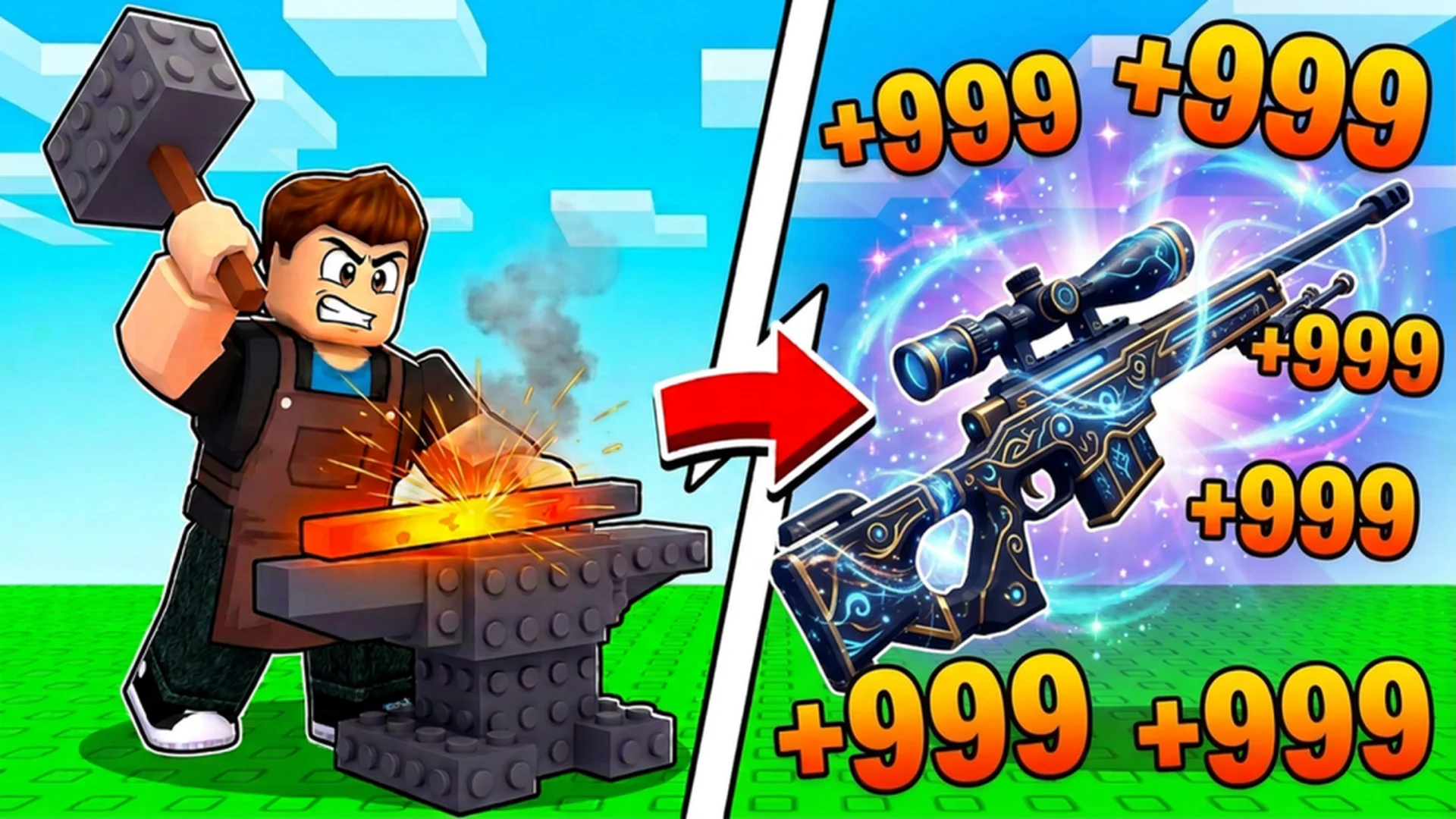
- Gun Forge forging system turns collected ores and materials into weapons with different rarities, Power values, and attributes.
- Forge with a plan by saving materials for the next useful weapon instead of spending every resource immediately.
- Compare results directly against your equipped gun before keeping, replacing, or selling an item.
- Manage your backpack so dungeon runs return with valuable materials instead of ending at full capacity.
- Prioritize practical upgrades because rarity alone does not guarantee better progression.
How the Gun Forge Forging System Works
The Gun Forge forging system is the central equipment loop in +1 Gun Forge. Players collect ores and other materials, use the Forge interface to create weapons, and then compare each result with their current equipment. A successful upgrade can improve Power growth, combat performance, and access to stronger areas.
The system is best understood as a repeating cycle rather than a single crafting action:
- Build Power through shooting and Training.
- Enter accessible progression areas or dungeons.
- Collect ores and useful materials.
- Forge a weapon when the recipe is affordable.
- Equip meaningful upgrades and sell unwanted results.
- Repeat the cycle with stronger requirements and better targets.
Weapons come with different rarities, Power values, and attribute rolls, and each recipe lists its own material costs in the forge. The in-game recipe display shows every cost and probability at a glance before you spend rare resources.
| Forge Stage | Main Goal | Recommended Decision |
|---|---|---|
| Gather | Collect ores and materials | Keep items needed for the next planned weapon |
| Prepare | Check Power, inventory, and materials | Avoid forging when a stronger recipe is nearly affordable |
| Craft | Create a weapon through the Forge interface | Review the completed result before equipping it |
| Compare | Measure Power and useful attributes | Keep results that improve your current progression |
| Clean up | Sell duplicates or weak equipment | Preserve rare materials and free backpack space |
Power
- Measures the practical growth value of a weapon.
- Compare the result with your equipped gun.
- A direct Power increase is usually the clearest early upgrade.
Rarity
- Indicates the quality range of a forged result.
- Higher rarity can be valuable, but it is not the only factor.
- Check attributes and actual progression value before replacing equipment.
Attributes
- Additional traits can change how useful a gun feels.
- Favor attributes that support your current combat or farming route.
- Keep situational weapons only when they have a practical role.
Treat every forging attempt as part of a progression budget. Reserve enough materials for the next meaningful upgrade before chasing a better rarity or random attribute.
Step-by-Step Forging Workflow
A consistent workflow prevents wasted materials and makes it easier to identify whether forging is actually improving your account. Follow the sequence below whenever you return from a resource run.
Check Your Current Equipment
Review the equipped gun before opening the Forge. Note its Power, rarity, and useful attributes so you have a clear comparison point for the next result.
Identify the Next Practical Target
Open the available recipe or weapon options and choose a target that improves your current stage. Do not select a recipe only because its rarity looks attractive.
Confirm Your Material Reserve
Check whether you have enough ores for the attempt and still retain materials for your next planned upgrade. This is especially important after difficult dungeon runs.
Forge and Inspect the Result
Create the weapon, then compare its Power and attributes with your equipped gun. Inspect the complete result before making a final decision.
Equip, Store, or Sell
Equip a meaningful improvement, store a useful alternative, or sell a weak duplicate. Keep your backpack ready for the next resource run.
| Decision Point | Keep the Result When | Avoid Keeping It When |
|---|---|---|
| Power | It provides a clear increase over the equipped gun | The increase is negligible or absent |
| Rarity | It also improves Power or useful attributes | Rarity is higher but practical performance is weaker |
| Attributes | They support your current route or combat needs | They offer no benefit to your active progression |
| Material cost | The attempt fits your current reserve | It delays a stronger, nearly affordable target |
| Inventory space | The weapon has a planned use | It is a duplicate with no upgrade value |
The best early-game habit is to make comparisons quickly. A weapon does not need to be perfect to be useful; it only needs to improve the part of the progression loop currently slowing you down. If shooting is too slow, prioritize Power. If dungeon runs are inefficient, prioritize a weapon that helps you clear accessible content more reliably.
The strongest general routine is to forge when the result can improve your next activity, not simply when your inventory contains enough materials for any recipe.
Materials, Ores, and Backpack Management
Forging efficiency begins before the Forge menu. Dungeon and ore runs provide the materials needed for weapons, but every trip has a cost: travel time, enemy risk, limited backpack space, and the possibility of losing progress if you push farther than your current equipment allows.
Use a route that you can clear consistently. Entry-level areas are useful for learning the layout and collecting accessible materials. Standard farming routes are better for repeated upgrades, while deeper areas should be reserved for players who can handle their enemies without turning every run into a high-risk attempt.
| Route Type | Main Purpose | Risk | Inventory Rule |
|---|---|---|---|
| Entry route | Learn entrances and nearby resource locations | Low | Keep several open slots |
| Standard farming route | Collect materials for regular forging | Medium | Leave before the bag is completely full |
| Deep route | Search for higher-value or harder-to-replace materials | High | Set a return threshold before entering |
| Extraction route | Protect materials already collected | Variable | Leave when rare materials are secured |
A full backpack can make an otherwise successful run inefficient. Before entering a dungeon, sell unwanted duplicates and remove low-value items that are not part of your next forging plan. During the run, protect rare or difficult-to-replace ores first. If capacity becomes limited, common materials are usually easier to replace than a rare item needed for a future weapon.
Before the Run
- Clear unnecessary inventory space.
- Check the next weapon target.
- Keep enough room for valuable drops.
During the Run
- Follow a repeatable route.
- Collect materials in priority order.
- Avoid fights that exceed your clearing speed.
Before Returning
- Protect rare ores.
- Leave before capacity blocks better drops.
- Do not risk a valuable haul for low-value extras.
Do not continue a dangerous run just to fill the final backpack slots. Returning with rare materials is often more valuable than collecting several common items and risking the entire haul.
Choosing the Right Forging Priority
The best forging priority changes as your account develops. Early players generally benefit from affordable weapons that provide immediate Power. Mid-progression players should balance Power, material cost, and reliable dungeon performance. Later players can save premium materials for high-requirement weapons when lower upgrades no longer produce efficient gains.
| Progression Stage | Forging Priority | Material Approach | Best Use |
|---|---|---|---|
| Early game | Immediate Power increase | Spend common materials carefully | Replace the starter weapon |
| Mid game | Power plus useful attributes | Save materials for reliable upgrades | Improve dungeon and ore efficiency |
| Late game | High-value long-term weapon | Protect rare materials | Target stronger areas and milestones |
| Any stage | Practical performance | Compare every result directly | Avoid rarity-only decisions |
Use the following principles when deciding whether to continue forging:
- Forge now when the recipe gives a realistic improvement and your material reserve is healthy.
- Wait when a significantly better target is almost affordable.
- Replace equipment when the new gun improves Power or helps clear your current route.
- Keep an alternative only when its attributes support a different activity.
- Sell duplicates when they occupy capacity and have no clear future use.
- Stop chasing rarity when repeated attempts are slowing your wider progression.
The forging system works best when it supports a broader account goal. For example, a weapon that allows consistent dungeon clears may be more valuable than a slightly rarer result that does not change your route. Likewise, a moderate Power upgrade can be worthwhile if it reduces the time needed to reach Training or Rebirth milestones.
Before You Spend Materials:
- Check the next available weapon target
- Compare the recipe with your equipped gun
- Reserve materials for a planned upgrade
- Confirm enough backpack space for the next run
- Decide whether the result will improve Power or clearing speed
Use rarity as a comparison signal, not as the final verdict. A lower-rarity gun with a stronger Power increase or better practical attributes can be the better progression choice.
Forging and Long-Term Progression
Forging is connected to the wider progression systems in +1 Gun Forge. Shooting builds Power, Training provides a dependable growth option, dungeons supply materials, and Rebirth creates a planned reset for stronger future cycles. The best Forge decisions support these systems instead of competing with them.
Before a Rebirth, claim available offline rewards, finish useful training progress, and organize materials. Avoid spending every resource on uncertain attempts if a clear upgrade is already affordable. After the reset, use the earliest efficient weapon improvement to rebuild momentum.
| Long-Term Goal | How Forging Supports It | Practical Focus |
|---|---|---|
| Increase Power | Provides stronger equipment | Choose clear upgrades over cosmetic rarity |
| Reach new areas | Improves combat consistency | Forge for the strongest area you can clear |
| Farm better ores | Reduces run difficulty | Upgrade when it improves route efficiency |
| Prepare for Rebirth | Shortens the current cycle | Avoid low-impact spending near the reset |
| Use offline rewards | Converts saved resources into upgrades | Claim rewards before major purchases |
A useful progression pattern is:
- Train when active combat is not providing efficient growth.
- Fight and collect materials when your equipment can clear the route consistently.
- Forge when the next weapon improves your current bottleneck.
- Sell surplus items to maintain capacity and fund progression.
- Rebirth when the current cycle slows and the reset offers better long-term value.
The official Roblox game page should be checked for current interface details and availability. The Battle Carrots Roblox community is also the relevant official group reference for game-related announcements and rewards.
Q: What is the Gun Forge forging system?
It is the equipment crafting loop in +1 Gun Forge. Players collect ores and materials, forge weapons, compare Power and attributes, then equip, store, or sell the results.
Q: Should I forge every time I have enough materials?
Not necessarily. Forge when the result supports your next progression goal and when the attempt does not consume materials reserved for a stronger planned weapon.
Q: Is the highest rarity always the best weapon?
No. Rarity matters, but Power, useful attributes, material cost, and actual performance in your current route also determine whether a weapon is worth keeping.
Q: What should I do with unwanted forged weapons?
Keep an item only if it has a clear upgrade or alternative role. Otherwise, sell duplicates or weaker results to free backpack space and support future progression.
Build a target before you forge, protect materials during dungeon runs, and judge every weapon by the progress it creates. This approach keeps the forging loop aligned with Power, Training, Rebirth, and world progression.